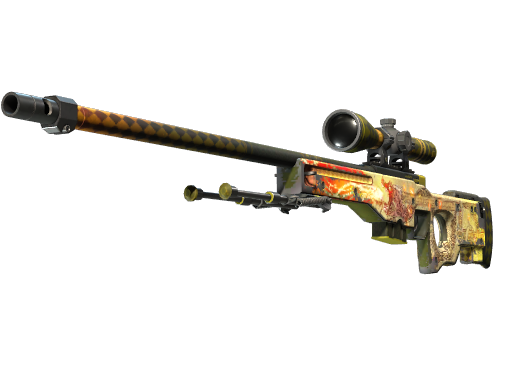
Souvenir skins are the most polarized segment of the CS2 market. A Souvenir AWP | Dragon Lore with gold stickers sells for tens or even hundreds of thousands of dollars, while a Souvenir Galil AR | Sand Dune from the very same tournament drop can be bought for less than a cup of coffee. Between these extremes lies a whole economy with its own rules — one most players do not understand, which is why they either sell valuable souvenirs for scraps or overpay for junk with a yellow label. Let's break down how souvenirs work and what their price is actually made of.
What a souvenir skin is
A souvenir skin is a special version of an item that exists only thanks to major tournaments. It is easy to recognize: the yellow Souvenir label in the name, the golden quality border and event stickers sealed directly into the skin. The key difference from a regular skin with stickers: souvenir stickers cannot be removed. They are part of the item forever, like an engraving. Every souvenir skin carries the stickers of the tournament, the two teams that played the specific match, and the MVP of that match — the skin literally documents a moment of esports history.
Where souvenirs come from: Major packages
During Majors — the flagship CS2 tournaments — viewers get a chance at a souvenir package drop. Packages used to drop for watching streams; in recent years Valve has tied drops to buying a viewer pass, but the core idea is unchanged: a package is tied to a specific match of a specific tournament. Inside the package is one souvenir skin from the collection of the map that match was played on. A match on Dust II gives a Dust II collection package; a match on the legendary Cobblestone (while the map was in the Major rotation) gave a Cobblestone package. A package can be opened — or sold sealed, and sealed packages trade as a collectible asset in their own right.
Here hides the first price lever: the map collection decides everything. The Cobblestone collection contains the AWP | Dragon Lore — one of the most expensive rifles in the game. The Dust II collection holds a pile of cheap skins like Sand Dune. Packages from the same tournament can cost $5 or $200 — depending on the map and the matches.
Why the prices are so polarized
The price of a souvenir skin is built from several multipliers — and they multiply, not add.
| Factor | Impact on price | Example |
|---|---|---|
| Base skin | Decisive | Dragon Lore versus Sand Dune — a difference of thousands of times |
| Rarity within the collection | Huge | The collection's Covert slot drops from a package in a fraction of a percent of cases |
| Event stickers | Strong | Gold stickers of top players multiply the price several times over |
| Match teams and MVP | Noticeable | Stickers of legendary rosters and a star MVP are valued higher |
| Tournament year | Noticeable | Early Majors — fewer packages in circulation |
| Float | Standard | Factory New versus Battle-Scarred, same as regular skins |
| Collection status | Growing over time | Map left the rotation — no new packages drop |
Hence the polarity. A Souvenir Sand Dune is a cheap base skin, a frequent drop, visuals nobody wants: the price is pennies, and the yellow label does not save it. A Souvenir Dragon Lore is a top-tier skin, the rarest slot of its collection, with a finite number of Cobblestone packages in existence: even the base version costs as much as a car. Here, by the way, is the regular (non-souvenir) Dragon Lore — a market legend in its own right:
The souvenir version of the same skin in the same condition trades even higher — a rare case for CS2: souvenirs are usually valued on par with or below the regular version, but for a select few collectible items the Souvenir prefix works as a multiplier.
Gold stickers: a multiplier on top of a multiplier
Player stickers deserve their own chapter. If the MVP of the match a package is tied to was a star player, his gold sticker is sealed into the skin forever. Collectors buy souvenirs with gold stickers of s1mple, ZywOo or NiKo at multiples of the price of the same skin with no-name stickers. The combination of "expensive base skin, iconic match, gold sticker of a legend" is no longer a skin — it is a museum piece with a price tag to match: these are exactly the lots that set auction records.
Souvenirs are never StatTrak
An important technical restriction: souvenir skins never carry a StatTrak counter. The two modifiers are mutually exclusive — an item is either Souvenir, or StatTrak, or regular. That is why a souvenir should be compared against the regular version, not the StatTrak one: they serve different audiences. StatTrak is bought to play and rack up kills; souvenirs are bought to own a piece of tournament history. For more on how the counter affects price and who actually needs it, see StatTrak vs normal skins.
To see what a live per-marketplace price comparison looks like, here is the iconic regular AK-47 — the checking mechanics are identical for any item, souvenirs included:
The investment angle: scarcity on a schedule
Souvenirs have a property that case skins lack: the supply is finite and known in advance. Valve can keep cases in the drop pool for years, and the supply of skins from them keeps growing. Souvenir packages drop only during a specific tournament — once the Major ends, no new packages of that event will ever exist. And if a map leaves the competitive rotation, as happened with Cobblestone, its entire souvenir line stops replenishing altogether. From there, simple arithmetic takes over: packages get opened, sealed ones become scarcer, skins settle into collections — supply shrinks while demand holds or grows. This is exactly why sealed packages of retired collections have appreciated faster than most skins for years.
But sobriety is mandatory. First, liquidity: selling a rare souvenir quickly and without a discount is hard — buyers for niche collectibles are few. Second, the entry threshold: meaningful collectible positions start in the hundreds of dollars. Third, the souvenir market is opaque, and without comparing prices across platforms it is easy to overpay: the spread on rare items can be several times wider than on liquid skins. And remember that opening a package is the same lottery as opening cases: the expected-value math is against you — details in our breakdown of CS2 case opening odds.
Bottom line
A souvenir skin is a document of an era: a tournament, a match, the teams and the MVP, sealed into an item forever. The price is made by the base skin and its map collection, the rarity of the slot, the gold stickers of stars and the finiteness of supply — while the yellow label by itself is worth almost nothing. Check a souvenir's price against the regular version in the catalog, compare platforms — and the polarized souvenir market will start working for you instead of against you.